


There’s a special kind of silence that happens right before a big problem reveals itself. The “wait… that’s not supposed to be there” silence.
And you could feel this silence in crypto’s software supply chain recently.
A massive breach hit NPM, the public toolbox developers use to build half the internet – including a ton of Web3 infrastructure.
If you’ve ever used a wallet, an ENS name, or anything remotely Web3-ish, there’s a good chance some of that code came from NPM.
And this week, 400+ of those packages got infected with a malware worm called Shai Hulud.
|

That includes real-deal components like ENS content-hash and ensjs – the stuff that makes human-readable blockchain names actually work.
You know, the difference between sending tokens to “alex.eth” instead of “0xA93BxF…whatever.”
Every time someone downloaded one of the infected packages, Shai Hulud got to work: stealing secrets, leaking private data, and spreading into any new project it touched.
According to security firm Wiz, it was adding new victims every 30 minutes.
And shoutout to Charlie Eriksen, the researcher who caught it and hit the alarm.
|
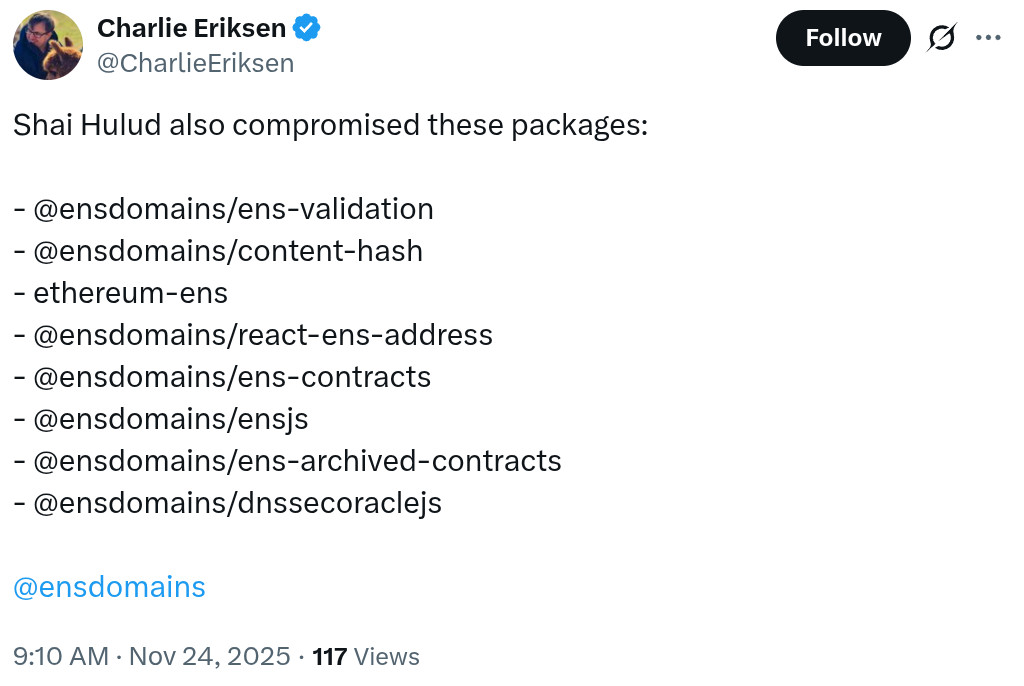
Now, if you’re not a developer, it’s easy to shrug this off with a “well, I don’t code, so… ok? ?“
But here’s the thing: when the tools developers rely on get tampered with, everyone downstream is at risk.
Users can lose privacy, funds, or access – without ever touching a sketchy link. That’s what makes supply-chain hacks so nasty: the damage happens before the app even reaches your screen.
The good news? Open source moves fast. Once the worm was spotted, patches started rolling out, and the infected packages were removed. The fire didn’t burn the whole house down.
But the risk doesn’t disappear just because the smoke clears. This is the reminder nobody asked for: crypto isn’t only about charts, pumps, and airdrops. It’s also about trusting the math, the code, and the tools underneath it all.
So yeah… maybe peek into your digital toolbox once in a while before you start building.
Because sometimes the thing that bites you isn’t a market crash – it’s the bug hiding in your dependencies.