



Accounting and finance are crucial business functions of any business that enables organsiations to plan and manage financial operations and make strategic decisions.
While Accounting is a systematic process of recording, organising, and analysing financial transaction information, helping businesses track performance and make informed decisions, Finance involves managing money, assets, investments, and financial resources to support financial planning, business growth, and decision-making.
Both processes are complex, which is why the finance and accounting team depends on various tools and software to manage these tasks daily. Traditional accounting and finance software is an integral part of the organisations, which is now being upgraded using AI to make it more efficient and meet modern needs.
AI-based accounting systems are programmed to think, learn, and generate accurate responses and results. It combines a wide range of technologies such as machine learning, NLP, OCR, RPA, and RAG to process large volumes of finance data. AI and ML-powered accounting and finance systems identify patterns and execute tasks automatically with minimal human intervention. Along with this, there are several other use cases of AI, from automating query resolution to advanced processing.
Here is a detailed use case of AI in accounting and finance, and what businesses should know about the integration of AI for their organisation.
5 Use Cases of AI in Accounting & Finance

The global AI in accounting market size was estimated at USD 4,872.7 million in 2024 and is projected to reach USD 96,686.1 million by 2033, growing at a CAGR of 39.6% from 2025 to 2033. (Source: GrandViewResearch)
Another report by Markets and Market states that the finance market value grew from USD 38.36 to USD 190.33 from 2024 to 2030, growing at a CAGR of 30.6%.
The above stats show the wide acceptance of AI in accounting and finance. Let’s explore the key areas where AI is creating measurable operational impact across the finance department.
Automation of Repetitive & Routine Finance Tasks Using AI
Most organisations have integrated AI in Accounting and Finance over the past few years to streamline various repetitive tasks such as data entry, bookkeeping, invoice processing and transactions management. Handling these tasks manually is time-consuming and prone to human errors.
Let AI automate and manage these repetitive tasks more efficiently. Connect with our team at PrimaFelicitas to explore how AI can be effectively integrated into your finance workflows with a structured implementation roadmap.
In fact, this use case of AI in accounting and finance is being implemented by organisations of all sizes, be it enterprises and small and medium-sized finance firms. Various surveys suggest that the automation of repetitive tasks is helping the accounting and finance professionals save up to 12 hours per month.
Finance Data Analytics Using AI
Data analytics remained the top AI workload among financial services firms in 2025. According to an industry survey, 68% of companies said they were using or assessing AI for data analytics. (source: Statista). Here is how it works-
- Automated Data Processing: AI collects and analyses financial data received in the form of invoices, statements, spreadsheets, emails, and connected systems like portals and ERP automatically.
- Predict or Forecasting Finance Related Transactions: AI and ML-based systems analyse historical financial data and market trends to predict cash flow, forecast business revenue, and business performance quarterly or yearly.
- Risk Analysis and Fraud Detection: AI systems can identify unusual and suspicious transactions, undesirable activities, and inconsistencies. It automatically sends a notification to the concerned team to analyse the case on priority. This helps the team to detect a risk early on and prevent fraud.
- Real-Time Reporting via Dashboards: AI- powered analytics tools generate real- time reports and enable the team to monitor and track all activities via an interactive dashboard.
- Supports Decision Making for Finance Teams: AI- enables the finance team to convert complex data into insightful data-driven datasets. This saves time spent in manual analysis and enables the finance professionals to focus on strategic decision-making and business growth.
Leading firms such as J.P. Morgan are using AI for payment validation screening and to automatically show insights to clients, such as cash flow analysis, when they need it.
Automated Document Processing Using AI
The Accounting and Finance team handles multiple documents in various formats, such as invoices, verification documents for KYC, transactions-related documents, and more, for day-to-day activities. The modern AI automated document processing system is designed to handle an end-to-end workflow. Here is how it works-
- The AI system captures documents from multiple sources and, using OCR, converts scanned documents into machine-readable texts.
- ML identifies patterns and helps organise and manage data accordingly.
- The data validation engine validates data against ERP data, historical records, or business rules.
This results in reduced manual workload, faster document processing, enhanced visibility, and improved client/customer experience.
Also Read: End-to-End Architecture of an AI Automated Document Processing System
AI in Accounting and Finance for Fraud Detection & Risk Management
AI- powered systems continuously monitor the records and transactions to detect any unusual behaviour and anomalies. It flags suspicious activity and enables the team to take action quickly before major financial loss.
HSBC is actively using AI to check 980 million transactions for any sign of financial crime each month. Here is the highlight of the result HSB has achieved so far with the integration of AI for fraud detection and risk analysis.
- AI has helped organisations reduce the processing time that was previously spent in analysing billions of transactions across millions of accounts. The processing time has been reduced from several weeks to a few days.
- AI systems have improved in terms of the precision of financial crime detection. It generates fewer false alerts, which helps save the team’s time in investigation.
- The team is now able to find signs of financial fraud faster without impacting customers.
- Using an AI system, the organisation is now able to provide more useful information to law enforcement, thus contributing more effectively to fighting against financial crime.
Transform your finance and accounting processes with intelligent AI automation. Speak with the team at PrimaFelicitas to discover scalable AI solutions for modern finance operations.
Compliance and Regulatory Reporting
AI and ML systems train from databases and historical records to interpret tax regulations automatically. It helps prepare filings and ensures compliance. Fast processing prevents the organisations from facing penalties. Here is how the AI tool works-
- Supports the team with the documentation of the compliance journey
- Organises all documents and reports in one place for quick assessment of risks.
- Collects supporting evidence and documents in one place
- Guides the team to achieve the highest level of compliance
How Mid and Small Scale Finance Can Use AI in Accounting and Finance Effectively?
The real value of AI in Accounting and Finance is truly defined by its application by small and mid-scale accounting firms. In fact, these organisations need to use AI more effectively to gain maximum productivity with limited resources. They can double their operational speed with the same skilled professionals in the accounting and finance department.
Here, we have highlighted the key factors that organisations that are planning to scale using AI must consider while implementing the same in the existing business environment.
Understand Business Requirement to Integrate AI
Leaders must clearly define how AI can help improve their business operations. It can start with basic automation of repetitive tasks, document processing, or chatbots to resolve client/customer queries.
Once the requirement is clear, they must draft a comprehensive AI strategy that aligns with the business objectives. This must include-
- Highlights the key areas where AI must be integrated with finance and automation workflows.
- Access the existing systems and their compatibility to upgrade using AI
- Set a realistic timeline to deploy AI-powered systems.
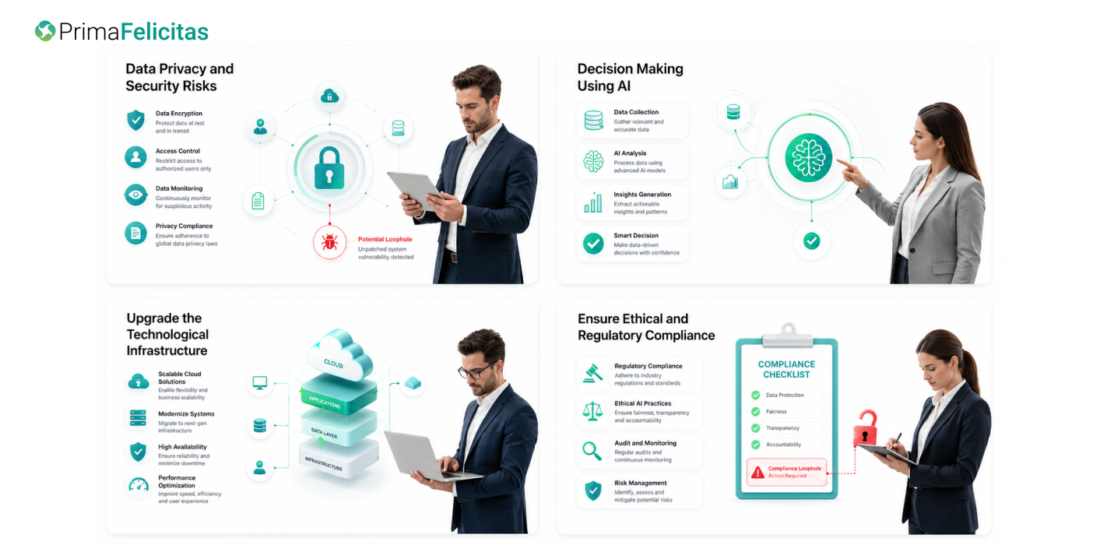
Do Not Overlook Security and Ethical Use Challenges
While AI offers multiple benefits for the accounting and finance firms, its adoption is critical, especially in the finance space, where organisations need to handle sensitive data.
The key areas to stay focused on are–
- Data Privacy and Security Risks: AI systems should maintain confidentiality and integrity, and ensure that data is not mishandled in any way.
- Decision Making Using AI: If AI is being used for decision-making for critical tasks such as financial audits and fraud detection, it must be fair, transparent, unbiased, and explainable.
- Upgrade the Technological Infrastructure: The integration of AI requires a robust and scalable digital infrastructure. The organisation must focus on the foundation layer first, like quality of data and the standardisation of finance systems, to ensure secure and seamless AI integration.
- Ensure Ethical and Regulatory Compliance: The team must adhere to regulatory guidelines on the use of AI. The internal team must ensure to maintain transparency with the use of AI. In the initial phase, the output must be regularly monitored by the team to ensure that it meets regulatory compliance and ensures ethical use of AI.
Conclusion
Most accounting and finance firms have already implemented AI for automating routine tasks. The finance professionals are now utilising it to enhance data analysis and improve decision-making. It is enabling them to focus more on strategic roles.
Real-time financial reporting, data analysis and risk assessment are recognised as the key use cases of AI in accounting and finance and they are truly helping organisations with useful insights and improved efficiency.
FAQ’s
How does AI improve fraud detection and risk management in finance operations?
AI-powered finance systems continuously analyse large volumes of transactions in real time to identify anomalies, suspicious patterns, and unusual financial behaviour.
ML models recognise data patterns from historical and continuous feedback to help organisations detect potential fraud faster, reduce false alerts, strengthen compliance monitoring, and improve overall financial risk management.
How are accounting and finance firms investing heavily in AI-powered automation?
Accounting and finance firms are investing in AI based on business requirements, initial budget and are initially testing the capabilities of AI before scaling it fast.
The initial phase is automation of repetitive tasks, like reducing manual document processing workload, organising records, resolving queries in real- time and detecting anomalies and unusual transactions.
This has already helped organisations reduce the time spent in manual processing and improved the efficiency of the finance and accounting team.
What are the biggest challenges organisations face while integrating AI into finance and accounting workflows?
The major challenges include the compatibility of legacy financial systems with AI tools. Another concern is with data security and privacy. Organisations must ensure that no sensitive data is leaked through the integration of AI with the system.
Organisations also need skilled teams, a clear AI adoption strategy and a willingness to scale to achieve successful implementation.
Ready to automate repetitive finance workflows and improve operational efficiency? Get in touch with PrimaFelicitas to explore AI-powered solutions tailored to your organisation.
Post Views: 22