

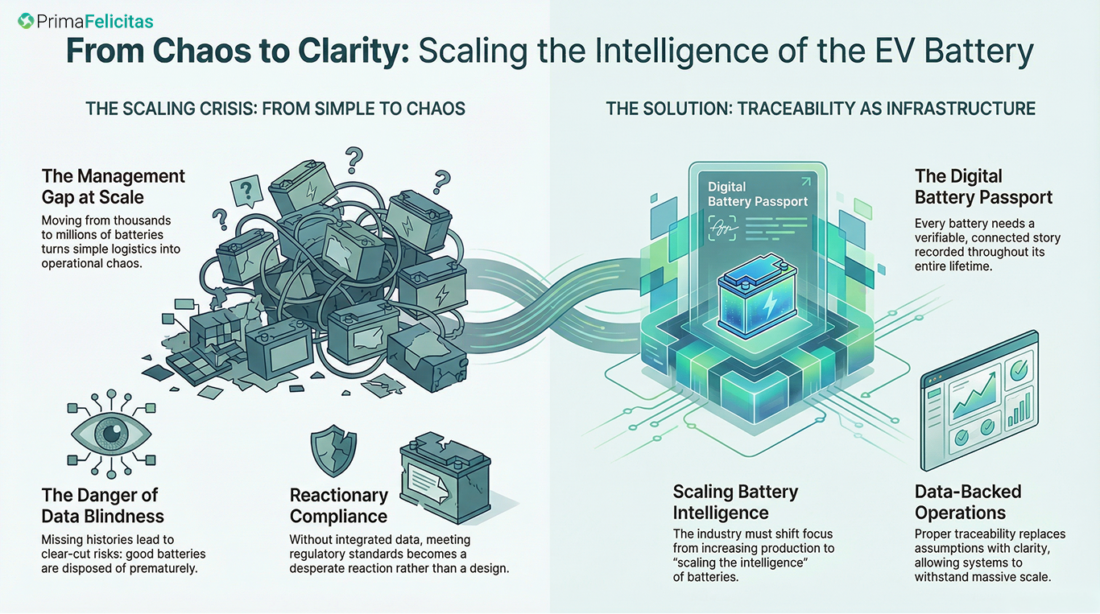


Digital Battery Passport (DBP) is a digital record of batteries that can be tracked using the unique ID generated for each battery. The EU regulations mandate DBP for all batteries circulating in the EU market, effective from February 18, 2027.
What does DBP look like? Users with access rights will be able to access the DBP using a QR code. Each Digital Battery Passport will have a unique battery ID to track further details like the use of raw materials, battery type, capacity, performance, as well as the reuse of materials from old batteries.
EV providers like Tesla and Audi have already run pilot projects on DBP to set a unified framework to measure carbon footprints, ensure human rights compliance, and support the circular economy.
Explore in detail what data needs to be included with the Digital Battery Passport (DBP) and how it is going to strengthen sustainable development and adoption of EVs.
What Data Does the Digital Battery Passport List and its Access?
The most common conversations around BDP are who can access it and what data it will cover. To bring clarity, we have listed the mandatory records that Digital Battery Passport (DBP) must contain at each stage of the battery lifecycle.
Stage 1: Origin and Source of Raw Materials
- Procurement details of Lithium, cobalt, nickel, and graphite
- Identity and other details of the supplier
- Due diligence documentation
- Carbon footprints associated with raw materials sourcing
Stage 2: Manufacturing & Production Phase
- Manufacturers details
- Date of manufacturing
- Country of assembly of components
- Battery specifications like capacity, performance, and health
- Battery type, total energy, and energy density
- Expected lifetime of the battery
- Greenhouse gas emissions
Stage 3: Battery Usage Phase
- ESG Data
- Material Flow
- State of health (SoH) over time
- Traceability and interoperability level
Stage 4: End of Lifecycle
- Benchmark and references to analyse quality
- Repurposing and Recycling details
- Material recovery rates
- Specific method or tools used for the dismantling of the battery
- Final material recovery rate
What is EU Battery Regulations News: Timeline & Rules 2027-31
Now that we know what the Digital Battery Passport is, let’s discuss the latest EU battery regulations news around battery traceability and DBP.
EU Regulations came into force in 2023 to trace the production, use, recycling, reuse, and disposal of batteries. The aim is to trace all activities and limit the release of carbon footprints throughout the battery lifecycle. Here is the upcoming timeline that is defined under EU regulations-
- February 18, 2027 (Extended Date): All industrial batteries and electric vehicle (EVs) batteries with a capacity of more than 2 kWh active in the EU market must have a Digital Battery Passport (DBP). The DBP record must be linked to a QR code to access information.
- August 18, 2031: By 2031, the EU has set a target to trace all batteries using QR codes.
Carbon Footprints Declarations
The manufacturers are already advised to mandatorily report the carbon footprints of each battery. The data must cover the battery lifecycle from raw material extraction to its recycling or disposal.
Supply Chain for Material Traceability:
Under EU regulations, companies are already conducting a supply chain due diligence. Specific attention is to track data of high-risk materials such as lithium, nickel, and cobalt
As per EU regulation, starting from August 18th, 2025, companies selling batteries in the EU market must mandatorily conduct a supply chain due diligence. Specific attention is given to high-risk materials such as lithium, nickel, and cobalt tracking.
Regulatory for the Auditing Team
The audit team needs to generate an annual report on data collection from suppliers and manufacturers to analyse risk. Details on responsible activities and carbon footprints enable authorities to take informed decisions to mitigate environmental impacts and human health risks.
Battery Recycling Process
EU regulations mandate a fixed percentage of materials used in the battery to come from recycled batteries. The regulations will be implemented effectively by 2031- 2036. Companies will need to share relevant documents highlighting the use of recycled materials from waste batteries.
The commission bodies need to define relevant methodologies to calculate recycling efficiency and verify the rates of recovery of materials. They must also set a format standard for documentation recorded in the Digital Battery Passport (DBP).
EU Battery Regulations: Key Highlights
Have a look at the key dates to ensure that companies are prepared before the deadline. This will help them stay relevant in the EU market and avoid penalties by regulatory bodies.
| Date | Activity | To whom it Concerns |
| February 28th, 2027 | Digital Battery Passport (DBP) is mandatory for | All industrial batteries and EV batteries with a capacity of more than 2 kWh, active in the EU market |
| August 18, 2031 | All batteries BDP in the EU must be traced using a QR code | All companies are associated with battery life cycles. From raw materials supply to recycling |
| By 2031 | EVs’ batteries must have the following percentage of materials recovered from old batteries- 85 % lead16 % cobalt6% Lithium and nickel |
EVs Batteries Manufacturer |
| By 2036 | EVs’ batteries must have the following percentage of materials recovered from old batteries- 85 % lead26 % cobalt5 % nickel12 % lithium |
EVs Batteries Manufacturer |
Benefits of Digital Battery Passport for the EV Industry
End-to-end traceability across the battery lifecycle enables companies, recyclers, and customers to use data for decision-making and improve the efficiency of the process. Have a look at the various benefits of DBP for all stakeholders associated with the battery lifecycle.
BBP for EV Companies
- Improve Credibility and Reliability: Verified data available through the digital battery passport can help build trust with the supply chain and activities throughout the battery life cycle.
- Informed Decision Making: Leaders across the battery ecosystem can fetch useful insights from the BBP and make important decisions.
BBP for Recyclers
- Safe Transportation of Used Battery: The risk assessment data (especially with the release of harmful chemicals) can be used to ensure that old batteries are transported safely.
- Ease Trade of Used Batteries: Information on battery capacity, degradation level, performance, and health enables the industry to set a benchmark to determine residual value and rates and streamline trade of reused batteries.
- Improve Efficiency of Recycling Process: Battery composition and dismantling guidelines can improve the efficiency of the recycling process and reduce the costs and efforts of recyclers.
Prepare for 2027 now! Invest in efficient battery traceability digital solutions and stay ahead of EU regulations. Connect with our team of Primafelicitas to discuss various possibilities.
BBP for Consumers
- Make Informed Purchase Decisions: End users or consumers can fetch information related to carbon footprints, sustainable particles, and battery lifespan to make informed decisions on EV purchase and other related products.
- Residual Value determination: Standards and regulatory frame enables consumers to pre-determine the battery’s residual value post its lifespan.
While DBP benefits all stakeholders across the battery lifecycle, its application and use must be communicated to keep everyone well-informed and aligned.
Challenges with Digital Battery Passport Implementation
Battery passport issuers are likely to face technical challenges while implementing DBP. SMEs and companies may face resource-related capabilities challenges as well as a lack of effective collaboration.
Technical challenges
- Difficulty with the creation, maintenance, and use of the battery passport
- DBP technical design and architecture challenges
- Fragmented systems and IT infrastructure used at different stages can lead to disconnection and a gap in effective communication.
Data standardisation and the lack of uniformity
- Data, if recorded in different formats and units at different stages, can make its integration with BDP difficult.
- The way battery metrics, such as State of Health (SoH) and carbon footprint traces, are calculated, and the level of efficiency in the recycling process is defined, which may vary, leading to inconsistency.
Supply chain challenges
- Interoperability challenges: In the absence of a transparent supply chain management and standards, sharing DBP may be inefficient.
- Gap in transparency: There may be data verification and transparency issues while collecting mining and supplier data.
- Data privacy with shareable data: companies and suppliers may feel reluctant to share certain information due to privacy and security concerns, especially with financial data.
Role of Emerging Technologies in Digital Battery Passport
Companies and authorised bodies must invest in emerging technologies sooner or later in alignment with regulatory standards to seamlessly implement DBP across the battery lifecycle. Let’s explore some of the best possibilities using technologies to make DBP implementation efficient.

Blockchain For Traceability
Design and develop blockchain-based battery traceability systems to-
- Create a verified and immutable record of the source of raw material used by manufacturers.
- Track the performance and health of batteries in real time using a decentralized distributed system.
- Keep a record of materials extracted from the old batteries and share the immutable record with the auditing team.
- Enable real-time visibility of data across the supply chain
- Create a tamper-proof data record of audit trails across the battery ecosystem
IoT Sensors for Battery Health Tracking
IoT sensors can be best used to trace the health of the battery. Let’s learn how-
- IoT technology, when combined with data analytics, can be used to create a real-time monitoring system to track EV battery health.
- The sensors can be used to record current, voltage, temperature, and state of charge (SOC) metrics.
- The data can be used to detect failure early on and optimize battery performance.
AI with Digital Battery Passport
The integration of AI with IoT devices and blockchain is best suited to analyse battery degradation and the remaining lifespan of batteries. AI helps improve data accuracy and automate processes wherever possible to improve efficiency.
Final Words!
Digital Battery Passport (DBP) is a novel approach to managing and tracking all activities across the battery lifecycle. While maintaining records was always a part of the system, it was often fragmented, lacking transparency and accountability.
By setting a standard framework for raw material sourcing, manufacturing, battery usage, and recycling, DBP strongly supports sustainability and empowers all stakeholders with improved efficiency. It enables manufacturers, recyclers, and consumers to make informed decisions with insightful data.
DBP is not just a mandatory EU guideline for companies. It helps them improve efficiency and support sustainability by tracing carbon emissions throughout the battery lifecycle, and also builds trust among customers. It helps improve collaboration among stakeholders to improve battery traceability and make the best use of it even in second-life usage.
We at PrimaFelicitas support future sustainable development with the implementation of reliable, scalable, and efficient digital solutions. Contact us at PrimaFelicitas to discuss various possibilities on seamless integration of technology with battery traceability projects.
Post Views: 187