



“Your battery data is lying to you.” Up to 30% of battery material is lost before manufacturing due to poor battery traceability, according to a McKinsey report. At the same time, the battery EV industry faces significant gaps in transparency and sustainability across the processes. There is a significant life-cycle inefficiency because some of the market faces a 6% recycling rate of lithium-ion batteries. The entire battery EV supply chain remains vulnerable and experiences value leakage throughout the lifecycle. These numbers and drawbacks are still persisting, and industries, as of now, understand the value of complete transparency over battery production. That’s why the battery systems are entering the phase where battery traceability is a structural necessity.
Over the last year, industries have been moving quickly and embracing revolutionary change across the EV battery industry. It is recommended that manufacturers, from 2025, mandate the verified lifecycle emissions. By 2027, there must be full battery passport compliance, which will be required at the time of production. There will be end-to-end analysis across stages (sourcing, production, and recycling). The global market will raise demand for batteries to nearly 6.8 TWh by 2035. Due to rising demand, there is a critical gap between supply chains because of the fragmented data. The only reason great demand needs a robust and structured system is that it can handle the data across regions, suppliers, and technologies.
That’s where industries are lacking, whether it is cell-level tracking or real battery data transparency across the chains. They need deep and experienced guidance from experts like Primafelicitas (experts in product traceability). After years of deploying the best possible solutions to the industries, they are empowering the next-gen visionaries. The company said, “What actually appears to be operational efficiency is just a disconnected system. The system where data exists but fails to flow; this is where the ecosystem got compromised and stopped scaling.”
Industries without battery lifecycle tracking systems, whether there is advanced EV battery traceability or not, still cannot produce measurable value. The reason is not inefficiency but rather the loss in compliance, decision-making, and adapting action in a rapidly evolving market. This is why industries are moving towardscircular battery supply chains. They are moving ahead to not only make it sustainable but also resilient, compliant, and margin-efficient systems at scale.
So the clarity is there, but the right guidance is still to be found. Do not need to worry because the information here will make it clear about today’s systems. The system is not so supported, and that level of visibility, accountability, or complexity is still not intact. This is exactly the right opportunity where you can connect to rethink how battery data is structured, tracked, and utilized.
Still Problem Persists: 3 Silent Gaps Killing Margins
Yes, industries are growing in terms of digital transformation while establishing sustainability. But still struggling to get that valuable output to make a trustworthy and reliable battery traceability system. Putting so much into data-driven insights will not help; rather, the structure, connection, and synchronization of data will drive the system. Maintaining these aspects will come into play and help in preventing long-term loss of competitiveness. Here are three key gaps that must be filled to grow the EV battery business.
Missing Data Architecture For True Cell-Level Visibility
The core problem lies within the system, and that is so fundamental that once it is solved, then the entire infrastructure enables consistent cell-level tracking. Commonly, the battery data are captured in the form of a pack or batches. But other data touchpoints like cell origin, chemistry, and performance degradation are still not linked across stages. This technical gap comes due to a lack of interoperability and integration. There are MES, ERP, and IoT working in silos without exchanging data and zero real-time synchronization. As per the recent industry analysis, battery manufacturers can be compromised while scrapping materials. They cannot be tracked back to the root causes; that is because of the limited data granularity. Without structured and well-planned battery data transparency, organizations are losing quality and understanding of maintaining quality.
Compliance Requirements Outspacing System Capabilities
The second most important part of battery traceability is battery compliance systems. That will decide the level of discipline and accountability in manufacturing so that no malfunction or unverified action can happen. To keep that level of quality across industries, by 2025, a carbon footprint will become mandatory. In the next few years, by 2030, it will be completely in the EU market. However, most of the systems are not built for consistent tracking because data is stored in fragmented formats and is lacking. So there should be a continuous, auditable battery lifecycle tracking system that can easily be validated across stakeholders.
To make it easier, the missing pieces are going to make it the ultimate battery passport compliance system.
- End-to-End Data Lineage Tracking
- Immutable data records (for auditability)
- API-driven data exchange across partners.
Without these layers, compliance becomes a reactive process rather than an integrated capability. As per the Global Battery Alliance, there are still industries in search of battery passport readiness. It is creating distance between market access and partnership eligibility.
No Closed-Loop Data Flow In A Circular Economy Shift.
While many industries believe in a circular battery supply chain. There are still companies that are into forward-only data models. In this particular case, once the battery leaves the initial stage, it is really difficult to trace the details. Hence, no true circular battery supply chain gets established. Industries must look at the perspective from the digital side, where the challenge is to keep identification through the process. There can be an inability to track state changes across ownership, usage, and reuse. Without EV battery traceability, it can be an assumption-based, data-driven approach rather than a calculative operation with verified data.
By 2035, the demand for batteries will have gone up by nearly 6.3 TWh globally. This is directly influencing the demand for raw materials and recycling systems. And without battery traceability, it can be inefficient and hamper the entire production stages. This is where consistently valued things get depleted and reused, and recycling can be underutilized.
The Bigger Impact
These gaps seem simple and individually resolved, but when they cumulate, they make it a continuous leak across the lifecycle. This makes a drastic change in cost efficiency; compliance risks grow, and detailed data is required. In a market where everything is dynamically changing, these kinds of persisting problems can no longer be sustainable. If you are an organization that continuously faces drawbacks, then it is really hard to create value, visibility, and accountability.
To know more about what EV battery traceability can do for your battery business, connect with Primafelicitas now. They have created a robust, valuable traceability system for a range of products while ensuring digital authenticity. The products include EV batteries, clothing, medical equipment, and more. You can schedule a meeting and connect with the visionaries.
How Battery Traceability Becomes A Margin Engine
Battery traceability is necessary for industries that need a proper structural execution. It is not just a visibility but also a validated and activated data-driven system across the entire lifecycle. Organizations that are working with the interconnected systems cannot build a battery empire with just isolated tools. They need an integrated system that collaboratively executes operations: manufacturing, supply chain, compliance, and recycling into a single dataset. The right solution will enable the organization to scale with regulatory, operational, and market complexity through 2030 and beyond.
Unified Data Architecture for End-to-End Battery Lifecycle Tracking
Most battery ecosystems are training IoT-backed systems that are capturing metrics like temperature, charge cycles, and performance. However, individually treating IoT as a solution for battery lifecycle tracking cannot be valuable in the long term. From a modern architecture perspective, IoT is now a foundational data capture layer. The real challenge begins when data is generated. Without structured integration, data is distributed and might be lost, and eventually lose its value. The IoT must be built into a unified data architecture so that tracking metrics can become usable intelligence. The IoT will revolutionize the shift from just managing tools to critical input layers from scalable battery traceability systems.
Build Persistent Digital Identity for True Cell-Level Tracking
Industries have seen a drastic change from tracking batteries from the unit to going deeper into cell-level tracking. This creates a persistent digital identity and makes a structured system where each cell carries a Unique digital identity. The identity remains consistent across its lifecycle, and it works as a key to all the associated data, manufacturing details, performance, etc. All this data is end-to-end stored in a single traceable thread. Without this particular layer, it cannot connect the two datasets from IoT or enterprise systems.
From a technical depth, it is really important to integrate an identifier approach into manufacturing to make sure authenticity of the material. This can positively impact the businesses and help in proactively managing the inefficiency at a granular level. Battery data transparency helps in unlocking value through accurate lifecycle insights, making it an actionable approach.
Enable Interoperable Data Architecture Across The Ecosystem
The battery ecosystem always comes with several stakeholders responsible for making to production to recycling. That one single cell passes by manufacturers, suppliers, logistics suppliers, regulators, and recyclers. So, to make a successful battery traceability system, it is important that the data is exchanged across organizational boundaries. This is where interoperability intelligence comes into play, and Primafelicitas builds those systems that can communicate in realtime. Already, the Battery Global Alliance is supporting standardization in global traceability systems.
Integrate Blockchain For Trust and Verification
Along with the large interconnected system, there is a risk of misuse of the data or tampering with touchpoints. It can make it difficult to find the bottleneck and disrupt the entire process. Renowned battery companies cannot maintain that level of genuineness among EV companies, which leads to performance and economic failure. There should be an intelligent layer within the battery passport compliance that can help stakeholders to check the data accuracy. That intelligent layer is a blockchain and distributed ledger system; this particular system helps in creating immutable and timestamped records. The system structurally and securely keeps every touchpoint at every transaction and state change.
The system keeps the data consistent and verifiable, making it easier for stakeholders to build trust and confident over production. This creates efficiency and accountability across industries, eventually becoming a successful battery economy. The economy that will help EVs to rise and shine. In technical terms, blockchain is not a replacement for any of the systems, but rather an additional reinforcement layer. The layer that secures cross-data points and makes a complete, coordinated ecosystem.
The impact is achievable in two ways: one is compliance readiness, and the second is to gain customers, partners, and regulators. This can be your company if you connect with the right advisors and developers like Primafelicitas, who have been working for decades to develop next-gen blockchain tech. They have helped industries across the globe, Europe, America, Britain, etc., to know more, click here.
Activate AI-Driven Intelligence For A Circular Battery Supply Chain
Now, the last layer of battery traceability is important in today’s infrastructure, which actually optimizes the entire system and makes it autonomous. That is the intelligence layer, yes, we have gone through that data, which must be actioned across systems to get the best output. But now there must be a mind that makes decisions and goes into deep analytics. That is where the AI plays its role and makes a calculated execution. Like predicting battery degradation, optimizing usage patterns, and identifying opportunities for second-life applications. This is important to run a true circular battery supply chain, where value never gets lost. As per McKinsey 2025, there can be an increase in demand for raw materials for the rise in EV battery usage. Without intelligent traceability, the growth will be in terms of inefficiency rather than resolving it. It will not replace humans in industries, but rather help them to speed up their work with complete accountability and efficiency. The smart, intelligent EV battery traceability will help in informed decisions about new, reuse, and recycling. This is where the business will admit measurable financial outcomes.
| Traditional Approach | Future-Ready Traceability System |
| IoT as a standalone solution | IoT as a data capture layer |
| Battery-level tracking | Cell-level tracking with digital identity |
| Siloed enterprise systems | Interoperable data architecture |
| Linear lifecycle | Circular battery supply chain with AI |
The above table presents why many organizations are transforming, or we can say will definitely transform in the coming years. Those organizations with battery traceability will experience system transformation. But without proper instructions and guidance, organizations might fall between their projects. That’s why working with partners will help in understanding the design of a layered architecture. The architecture includes integrating IoT, blockchain, AI, digital identity, etc., into a unified ecosystem.
There is a responsible company, Primafelictas, that helps the industry to design and deploy traceability systems. The systems that are aligned with global regulations and the evolving industry standards.
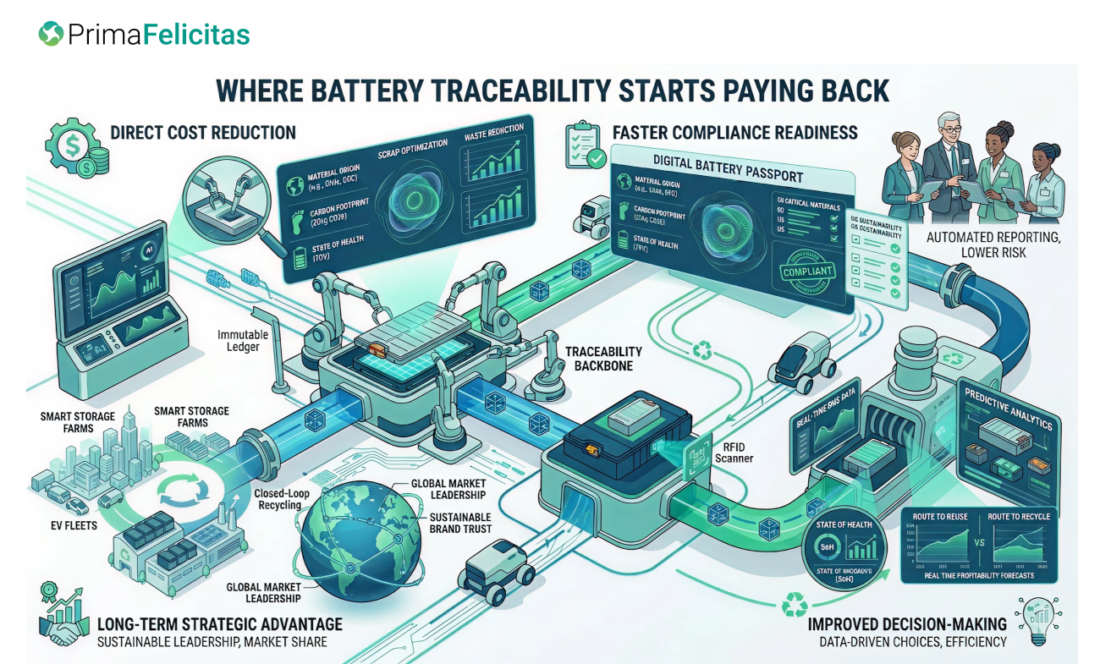
Where Battery Traceability Starts Paying Back

After implementing the battery traceability, the results are not going to be quickly visible. Rather, it shows gradually a value creating, retaining, and scaling across the battery lifecycle. The impact is not just on papers, but you can see across financial structures, compliance, and long-term operational efficiency.
Direct Cost Reduction Through Waste And Scrape Optimization
One of the positive outcomes of the battery lifecycle tracking is a reduction in wastage and inefficiency. With transparency, it will be easier for organizations to look into the cause of defects in cell production and performance. After that, it optimizes production processes. To support that, in the year 2025, there is an elevation of 20 to 30% in the scrapping and rework process. So with proper analytics and tracking process on a granular level, there will be a profitable outcome. By enabling precise cell-level tracking and battery data transparency, companies can significantly reduce material waste, improve yield rates, and lower overall production costs.
Faster Compliance Readiness and Reduced Regulatory Risk
With support for battery passport compliance, organizations will no longer rely on manual or fragmented systems. Compliance helps in the transformation of the system from a reporting activity to a continuous capability. There will be no second thought while maintaining the regulatory standards because the battery compliance system will automate data capture and then validate as per the standard. This will create a feasible process to sync with faster market access in regulated regions. This eventually minimizes the risk of fines and penalties. And in the regions where compliance directly influences the business continuity, this becomes a critical advantage.
Improved Decision Making Through Real-Time Data Transparency
The battery industry is interconnected, so there is faster and more informed decision-making. There is a need for end-to-end battery data transparency that help in stake holders to gain access to real-time insights that present actual system performance. This creates a strong team collaboration, reduces the hampering of operations, and enhances the response rates. Whether it is external and internal challenges in a complex ecosystem, the structured system can give confidence to make data-driven decisions. This is what the difference between operational efficiency and systematic inefficiency is.
Long- Term Strategic Advantage In A Scaling Market
As the battery market is growing, along with that, the system will also gain more complexity over the next decade. So the organization must be equipped with strong EV battery traceability that will help in managing growth without inefficiency. In this case, traceability will act as a catalyst in terms of scalability. It opens up organizations to expand operations, successfully integrate with new partners, and easily adapt to regulations without rebuilding core systems. This creates a long-term advantage for the industries to automatically gain operational control, compliance readiness, and cost efficiency while growing.
Conclusion
Industries are adopting new technological advancements, and after seeing the positive metrics, battery traceability is rapidly becoming a core requirement. Whereas Battery passport compliance adds a next-level security enforcement that makes it scalable with safety. This is pushing more organizations to invest and create a big EV battery economy worldwide. This can only be possible when the organization actively accepts battery lifecycle tracking and real battery data transparency. This will create a valuable non-ending profitable chain that also unlocks value across a circular battery supply chain. The real advantage lies in making wise decisions and making it a longer-term strategic capability.
Now you have made up your mind, if it is yes, then connect at Primafelicitas here. The team will guide till you get your battery traceability infrastructure ready and show positive results. They use a complaint architecture using blockchain AI that makes it faster to implement. Their solution makes it risk-free and drives long-term value across your battery ecosystem.
Post Views: 133